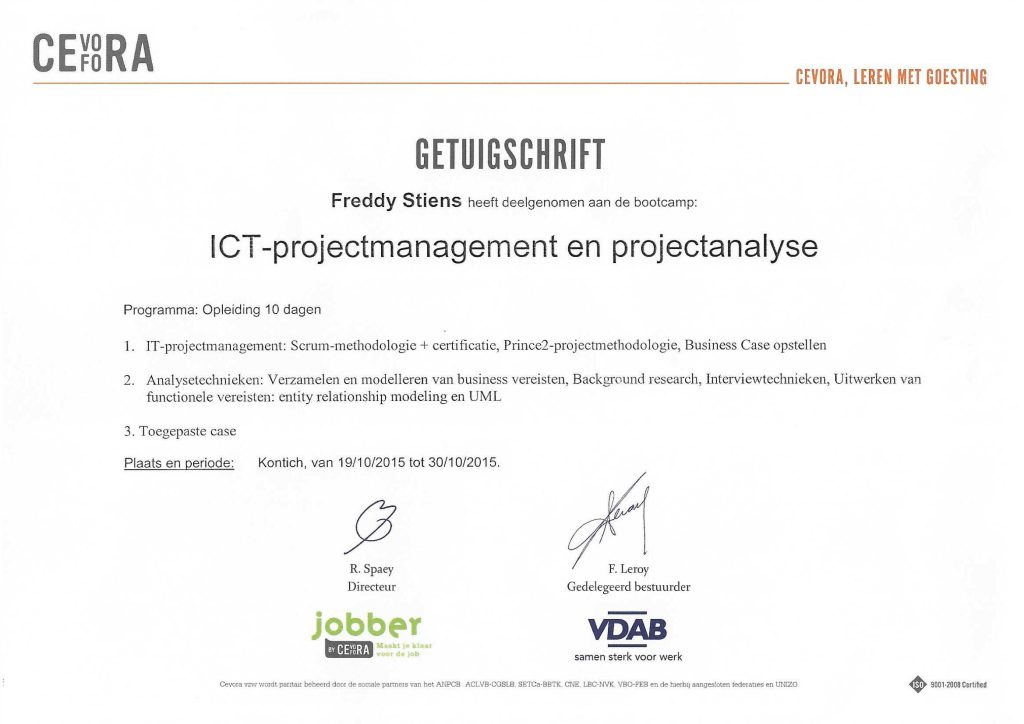
A technical engineer’s view on Scrum, PRINCE2 and UML
I followed the ICT Project Management and Project Analysis course at Cevora with a very pragmatic goal: to better understand how software projects should be structured, analysed, communicated, and controlled in real technical environments.
As an engineer, I have worked in contexts where projects grew organically, requirements evolved during use, and documentation was missing or didn’t create added value. This course provided a structured framework to reason about projects before they become complex, expensive, or fragile.
Why this course matters for engineers
Engineers are often pulled into project discussions without being given the tools to challenge scope, assumptions, or planning. This course filled that gap by focusing on three complementary pillars:
• Agile execution through Scrum
• Governance and control through PRINCE2
• Clear system modelling through UML
Together, these form a toolkit that helps engineers stay in control of complexity without losing technical depth.
Scrum from an engineering perspective
Scrum is often misunderstood as a management ritual. In practice, it is a technical feedback system. What I took from Scrum in this course is not the ceremonies, but the mechanics:
• Breaking work into testable increments
• Continuous prioritisation based on value and risk
• Fast feedback loops between development and stakeholders
• Early detection of wrong assumptions
From an engineering standpoint, Scrum forces architectural decisions to surface early. Poor abstractions or unclear requirements become visible within a sprint instead of months later. This is especially valuable in software intensive systems where requirements evolve once users interact with the system.
PRINCE2 as a control framework, not bureaucracy
PRINCE2 is often associated with heavy documentation. The course approached it differently. PRINCE2 was presented as a decision framework, not a paperwork generator.
Key takeaways:
• Clear separation between business responsibility and technical execution
• Explicit justification for why a project exists and continues to exist
• Defined roles, escalation paths, and decision authority
• Controlled handling of changes and risks
For engineers, this matters because it creates boundaries. It avoids situations where technical teams absorb unclear scope changes without formal impact analysis. In complex environments, especially public or regulated projects, this clarity protects both the system and the engineers working on it.
UML as a thinking tool, not just diagrams
UML was one of the most practically useful parts of the course. Not as a drawing exercise, but as a way to think precisely.
The focus was on:
• Use case diagrams to clarify functional scope
• Sequence diagrams to expose timing and interaction issues
• Class diagrams to reason about structure and responsibilities
• Activity diagrams to model process logic
Using UML forces ambiguity out of conversations. If something cannot be modelled clearly, it usually means it is not understood well enough.
As an engineer, this is extremely valuable during analysis and before implementation starts.
Added value in real projects
The real value of this course is not certification, but mindset.
It helps to:
• Ask better questions before building
• Detect project risks early
• Communicate technical complexity to non technical stakeholders
• Align development work with actual business objectives
• Avoid uncontrolled scope creep
For someone working at the intersection of engineering, software, and verification, this knowledge directly improves project quality and predictability.