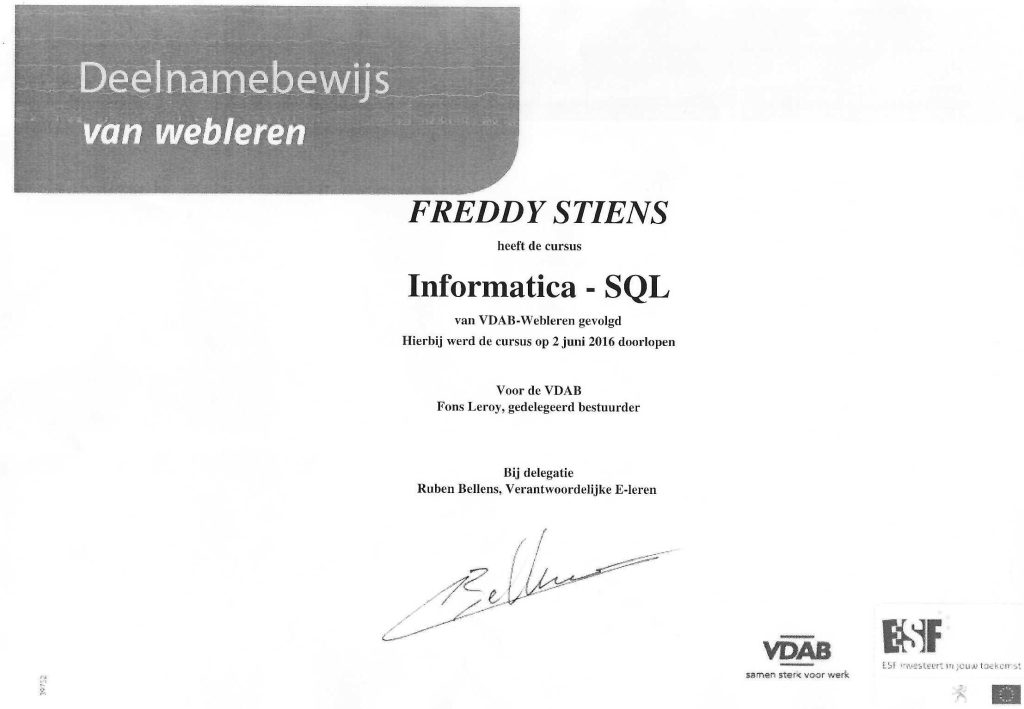
Course structure and approach
I followed an SQL course via the VDAB Webleren platform, with the goal of strengthening my database fundamentals as an engineer moving deeper into software testing and development. The course focused on core SQL concepts and combined online learning with practical validation by a teacher, which made it more than just a self study module.
The course was built around a clear progression. It started with the basics of relational databases and gradually introduced SQL syntax step by step. Each topic was immediately followed by exercises, so theory and practice were closely linked.
What I appreciated is that the course did not stay abstract. Besides the online exercises in the learning platform, we also worked with an offline database environment. This allowed me to execute queries locally, see real results, and make mistakes in a controlled setup that resembles real world usage much more closely.
Topics covered
The course covered the essential building blocks of SQL, including
• Selecting data from tables
• Filtering results using WHERE conditions
• Sorting and limiting result sets
• Working with joins between multiple tables
• Basic aggregation using COUNT, SUM, and GROUP BY
• Understanding primary keys and relationships
The focus was clearly on reading and writing correct queries rather than on memorising syntax. That aligns well with how SQL is used in practice.
Feedback and verification
A strong point of the course was the verification by a teacher. The offline exercises were reviewed, and feedback was provided when queries were incorrect or inefficient. This helped me understand not only what worked, but also why a certain approach was better than another. That feedback loop made the learning experience more solid than purely automated platforms, where you often only see whether an answer is right or wrong without deeper explanation.
Personal takeaway
From a student and engineer perspective, this SQL course gave me a solid foundation that I can directly reuse in software development, software testing and data validation. It helped me better understand how applications interact with databases and how data issues can be traced back to queries. It was not an advanced database optimisation course, but it was exactly what it promised to be: a clear and practical introduction to SQL, grounded in hands on exercises and validated learning.