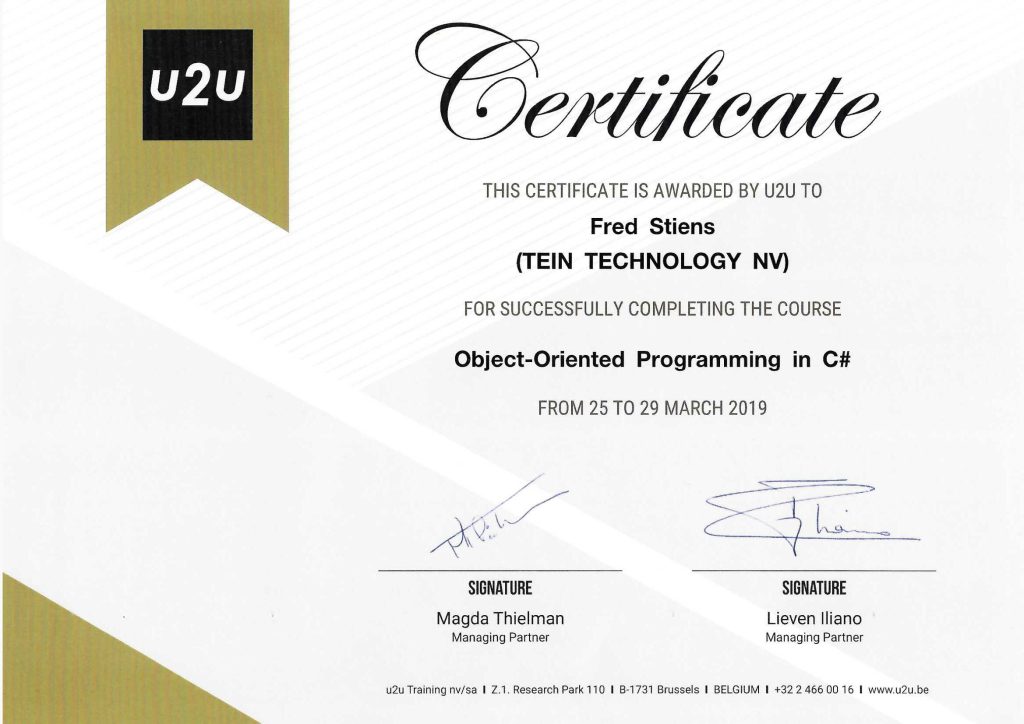
U2U Certificate Object Oriented Programming in C#
I completed the Object Oriented Programming in C# course at U2U and earned the corresponding certificate. It was a technical deep dive into how object oriented concepts are actually implemented in C# and how they influence software design in real projects.
I followed this course with the mindset of an engineer who wants to understand why certain structures exist, not just how to type them. That fits well with how I approach software quality and testing today.
What the course really covered
Based on the official course content and exercises, the focus was on the core pillars of object oriented programming, but always grounded in C# and .NET practice.
Core OOP concepts
Encapsulation using access modifiers and properties
Inheritance and when not to use it
Polymorphism through virtual methods and interfaces
Abstraction via abstract classes and interfaces
These topics were not treated as theory only. Each concept was implemented in code and executed during the course.
C# specific implementation details
Classes versus structs and when value types make sense
Constructors and object lifecycle
Readonly fields and immutability patterns
Properties versus fields and why it matters for maintainability
Use of interfaces to decouple components
Design quality and structure
Single Responsibility Principle applied to small examples
Avoiding god classes
Composition over inheritance in practice
Clear separation between domain logic and technical concerns
This part was especially valuable because it directly links coding style to long term maintainability and testability.
Practical exercises
Building small object models from functional descriptions
Refactoring procedural style code into object oriented designs
Identifying design smells and improving them
Working in Visual Studio with proper project structure
The exercises force you to think before coding. If your model is wrong, the code becomes messy very quickly. That feedback loop is exactly what you want as an engineer.
How I apply this today
I now look at C# code with a sharper eye.
Are responsibilities clearly separated
Can objects be tested in isolation
Are dependencies explicit or hidden
Is inheritance used because it makes sense or because it was easy
This directly supports my transition toward software development roles, where understanding the C# syntax and .NET framework is as important as writing code.