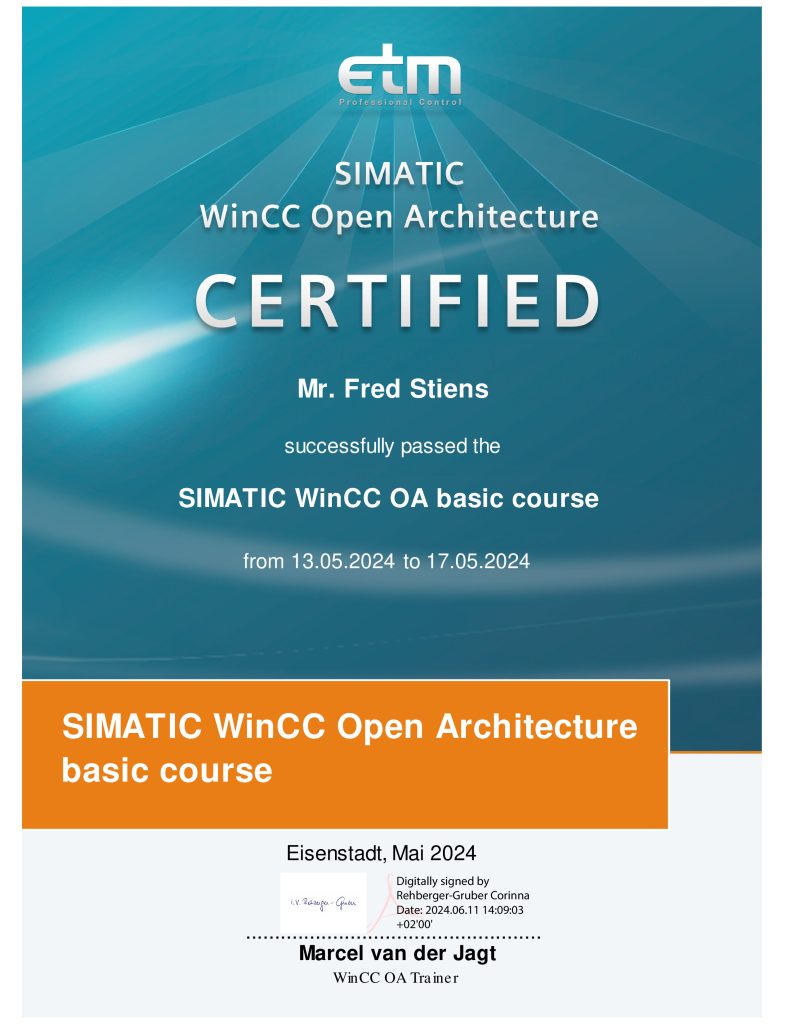
I completed the SIMATIC WinCC Open Architecture Basic Course, a professional training delivered by ETM Professional Control in The Hague in the Netherlands. This certification confirms my practical and theoretical knowledge of WinCC Open Architecture, one of the most popular SCADA platforms used in critical infrastructure and industrial environments.
The training took place from 13 May 2024 to 17 May 2024 and covered the essential building blocks required to design, configure, and operate a WinCC OA based system in a structured and reliable way.
Why WinCC Open Architecture matters
WinCC Open Architecture is widely used in environments where reliability, scalability, and long term maintainability are non negotiable. Typical domains include transport infrastructure, energy, utilities, and large scale industrial automation.
What makes WinCC OA particularly strong is its open architecture. It allows system integrators and engineers to go far beyond standard configuration by combining scripting, modular design, and strict separation of concerns. This makes it an excellent platform for complex systems that evolve over time.
What the training covered
The basic course focuses on building a solid foundation. Topics included:
• Core architecture and system concepts
• Data point types and data point elements
• Panel design and visualisation principles
• Event handling and alarms
• Scripting basics and logic structuring
• Project organisation and best practices
The emphasis was not only on functionality, but also on designing systems that remain understandable, testable, and maintainable over many years.
Part of continuous professional development
This training is one step in a continuous learning path. Technology evolves, but solid foundations remain essential. By combining platform specific expertise like WinCC Open Architecture with broader software testing and development knowledge, I aim to deliver solutions that are not only technically correct, but also sustainable and future oriented.
Certificates are not the goal on their own. They are tools to deepen understanding, sharpen judgement, and ultimately create better systems for people who depend on them every day.