Context and intent
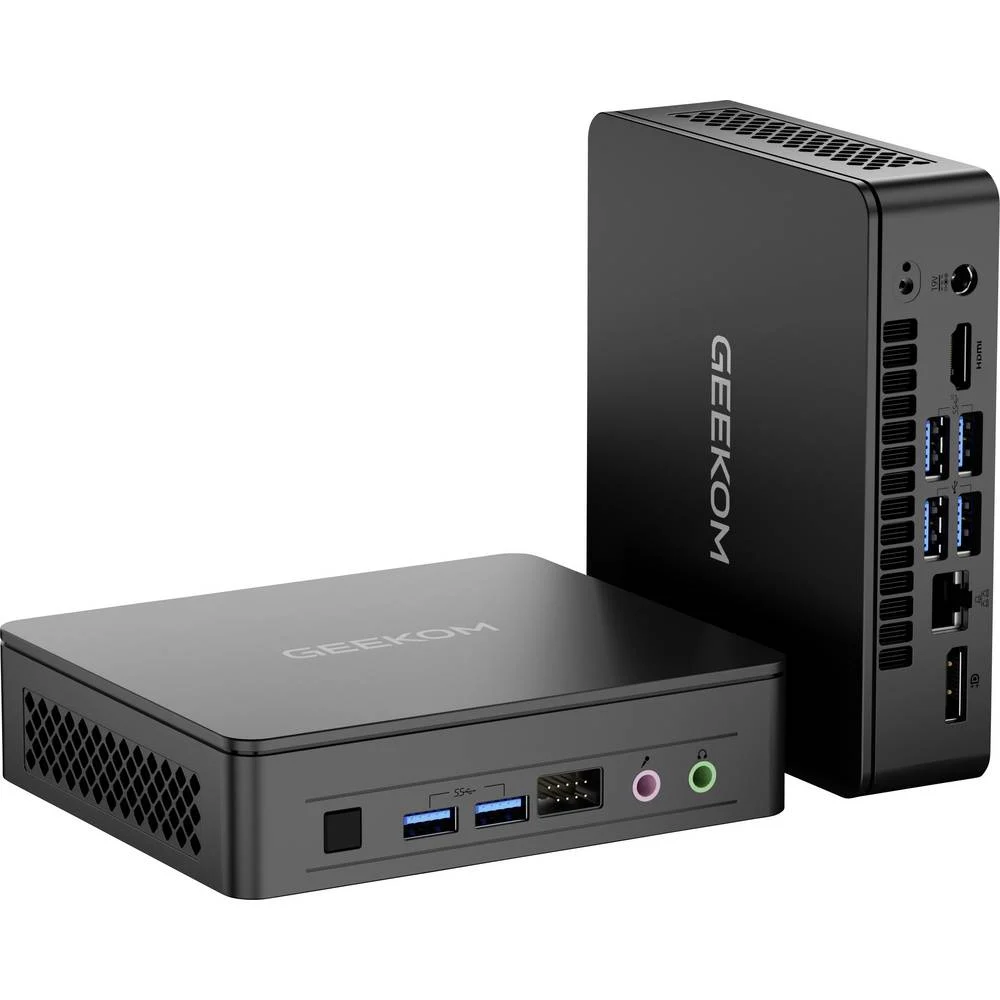
This GEEKOM Air12 Lite was bought for a specific, non glamorous job: running a RustDesk server on Ubuntu Server, always on, headless, silent, and low power. This review reflects that reality. It is based on one real machine, measured and used in production, not on averages or vendor claims.
Hardware overview
CPU: Intel N100, Alder Lake N, 4 cores, 4 threads, 6 W TDP
RAM: 8 GB
Storage: FORESEE 256 GB SSD
LAN NIC: MotorComm YT6801 Ethernet
OS: Ubuntu Server
Build quality and design
The enclosure is compact and light. Materials are acceptable, not premium. There is no unnecessary design effort here, which is fine. Cooling is conservative and fully silent. Under continuous operation, the system remains cool and stable. Port selection is functional but limited. Expansion options are minimal. This is expected in this form factor and price range.
Benchmark results
All benchmarks below were executed on this exact unit.
Synthetic benchmark summary
| Benchmark | Result |
|---|---|
| Novabench Overall | 611 |
| Novabench CPU | 327 |
| Novabench GPU | 14 |
| Novabench RAM | 184 |
| Novabench Disk | 86 |
| Cinebench R23 CPU Single | 874 |
| Cinebench R23 CPU Multi | 2623 |
| Geekbench CPU Single | 1126 |
| Geekbench CPU Multi | 2902 |
| PCMark 10 Overall | 3101 |
| PCMark 10 Essentials | 6560 |
| PCMark 10 Productivity | 4994 |
| PCMark 10 Digital Content Creation | 2470 |
Storage performance
CrystalDiskMark 8.0.6 results
| Test | Read MB/s | Write MB/s |
|---|---|---|
| Sequential SEQ1 | 553.95 | 513.62 |
| SEQ1M Q1T1 | 475.40 | 467.61 |
| Random 4K Q32T1 | 194.02 | 156.89 |
| Random 4K Q1T1 | 33.29 | 75.52 |
What the numbers actually say
The benchmarks are consistent across tools and tell a clear story. CPU performance is low but predictable. Single core performance is adequate for system services and background tasks. Multi core performance saturates quickly. This is not a general purpose desktop CPU. Disk performance is stable but unremarkable. It behaves like a decent entry level SSD. Fine for logs, configs, and light databases. Not suitable for heavy random I O workloads. System responsiveness is acceptable for administration and server use. PCMark confirms that basic tasks feel responsive, while content creation performance is clearly limited. Nothing here is surprising. The hardware performs exactly as its class suggests.
Network controller: a real weakness
The Air12 Lite uses a MotorComm YT6801 Ethernet controller. This is the most problematic component in the system for Linux users. On Ubuntu Server, the NIC works, but not with the same reliability as Intel network controllers. Depending on kernel version and configuration, issues may include unstable drivers, link negotiation quirks, or reduced reliability under sustained load. For a machine intended to be always on and remotely managed, this matters. CPU limits are predictable. Disk limits are manageable. Network instability is not. In practice, mitigation options include using a recent kernel, tuning power management, or bypassing the onboard NIC entirely with a USB to Ethernet adapter using an Intel chipset. That workaround works, but it should not be necessary. This is a clear cost saving choice by the manufacturer, and it shows.
Power usage and thermals
This is where the Air12 Lite justifies its existence. With a 6 W class CPU, the system is extremely power efficient. It runs silently, shows no thermal throttling during sustained operation, and is well suited for 24 7 usage. For server and infrastructure roles, this is more important than raw benchmark scores.
Suitable use cases
Good fit
Always on low power servers
RustDesk or remote access nodes
Monitoring, automation, and utility services
Light Linux server roles
Poor fit
Desktop replacement
Virtualization beyond very light use
Build servers or compile workloads
Disk intensive or network critical production systems
Verdict
Measured performance confirms that the GEEKOM Air12 Lite is a low power, low performance, predictable machine. It does not overperform. It does not underperform. It simply stays within its limits. As a RustDesk server, it works well. As a Linux mini server, it requires attention to networking.
As a general purpose PC, it is a compromise. This is not a machine you buy for flexibility or headroom. It is a machine you buy when you know exactly what you need and are willing to accept its constraints. The benchmarks were worth doing. They expose both what this system does well and where it clearly falls short.