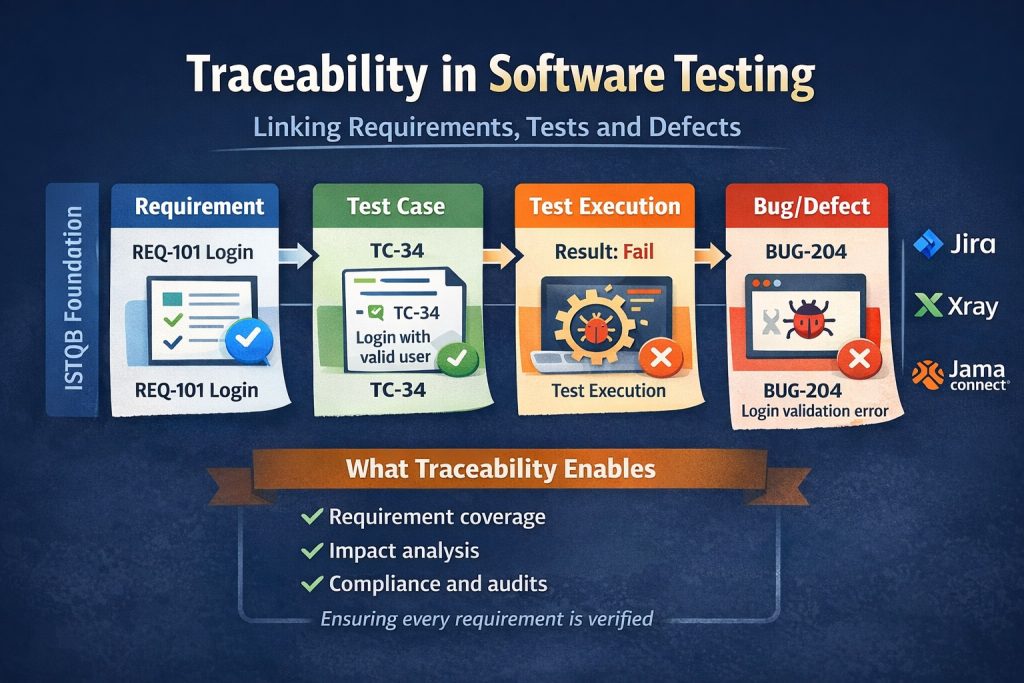
In software testing, traceability is one of the fundamental concepts taught in the ISTQB Certified Tester Foundation Level. In complex projects it becomes a powerful mechanism to ensure software quality. Traceability answers a crucial question in software development. How do we prove that every requirement has actually been tested?Without traceability, testing becomes fragmented. Requirements exist in one system, test cases somewhere else, and defects in yet another tool. The relationships between them can easily disappear. Traceability solves this by creating explicit links between all these elements.
What Traceability Means in ISTQB
In the ISTQB Foundation syllabus, traceability refers to the ability to trace relationships between different work products of the software lifecycle.
Typical artifacts involved are:
Requirement
Test condition
Test case
Test execution result
Bug
The relationships between these artifacts allow teams to see exactly what is being tested and what the outcome is.
A simplified traceability chain looks like this:
Requirement → Test Case → Test Execution → Bug
This structure allows a team to answer important questions quickly:
Which test cases verify a specific requirement?
Which requirements failed during testing?
Which defects are linked to a requirement?
This concept is usually visualized through a Requirement Traceability Matrix (RTM).
Example:
| Requirement | Test Case | Result | Bug |
|---|---|---|---|
| REQ Login | TC Login valid user | Pass | |
| REQ Password reset | TC Password reset | Fail | BUG 204 |
This matrix ensures that every requirement is covered by at least one test.
What you can achieve with traceability
Coverage Control
Traceability ensures that every requirement has corresponding tests. If a requirement has no linked tests, the gap becomes immediately visible.
Impact Analysis
When a requirement changes, traceability makes it easy to identify which tests must be updated.
Example:
Requirement REQ 45 changes.
The traceability links immediately show which test cases are affected.
Compliance and Audits
In regulated industries such as medical devices, aerospace or automotive software, traceability is mandatory. Auditors often ask for evidence showing that every requirement has been verified through testing. Without traceability this proof becomes extremely difficult.
Traceability in Jama
Jama Connect is a requirements and verification management platform designed for complex engineering projects. Jama focuses heavily on end to end traceability across the entire system lifecycle. A typical structure inside Jama might look like this:
Stakeholder requirement
System requirement
Software requirement
Verification test case
Test execution result
Each level can be linked to the next one. This creates a complete traceability chain from high level system goals down to the test evidence that verifies them. One of the strengths of Jama is bidirectional traceability. This means you can navigate both directions. From a requirement you can see all associated tests. From a test you can see which requirement it verifies. This is particularly important in industries governed by standards where traceability is a regulatory expectation.
Traceability in Xray for Jira
Xray Test Management for Jira is a test management extension for Jira that implements traceability using Jira issues and links.
In a typical setup:
Requirement is represented by a Jira Story or Requirement issue
Test case is represented by an Xray Test
Test execution records the result of running the test
Defects are recorded as Jira Bugs
The relationships between them form the traceability chain.
Example:
Requirement STORY 42
linked to Test TEST 88
executed in TEST EXECUTION 21
resulting in BUG 91
Xray can then generate reports such as requirement coverage.
These reports immediately show:
Which requirements have tests
Which tests passed or failed
Which requirements are associated with bugs
This makes traceability practical and visible for development teams.
Traceability in Practice
In real projects traceability often extends further than the simple ISTQB model.
A typical structure in a professional environment may look like this:
Stakeholder requirement
System requirement
Software requirement
Test case
Test execution evidence
Bug report
Each artifact is linked to the others.
This allows teams to answer critical questions during development or audits:
Which requirement does this test verify
Which requirements failed during testing
Which tests must be updated when requirements change
Without these links, maintaining software quality becomes significantly harder.
Traceability as a Foundation of Quality
Traceability is sometimes perceived as bureaucratic overhead. In reality it is a powerful tool for maintaining control over complex systems. For small projects it may be implemented with simple spreadsheets. For large engineering projects it is typically supported by professional tools such as Jama or Xray. Regardless of the tool, the core idea remains the same. Every requirement must be traceable to the tests that verify it and to the results that prove the system works as intended. This simple principle is one of the key building blocks of modern software quality assurance.