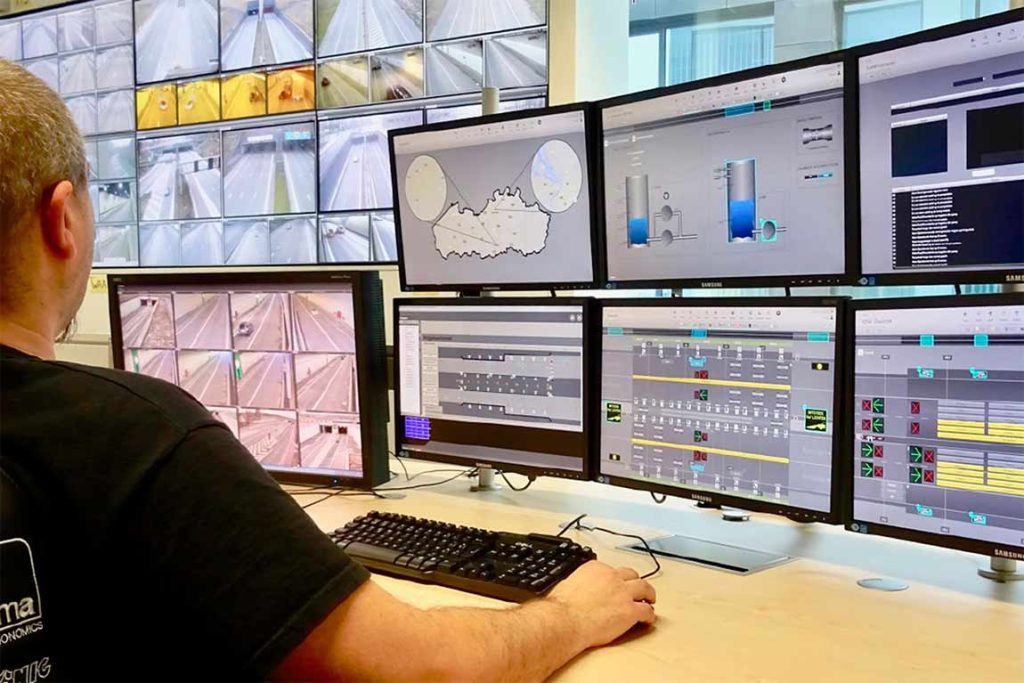
One of the most defining projects in my career was my role as SCADA developer in the Flemish Tunnel and Control Center in Antwerp.
This control center was created to meet the operational demands of the Trans European Road Network (TERN) and to enable centralized monitoring of all tunnel installations in Flanders. In its final form, the system became one of the largest SCADA based tunnel monitoring platforms in Europe, operating with roughly 150,000 external data points.
From concept to operational reality
The control system was built using evon XAMControl, with the Flemish government agency Agentschap Wegen en Verkeer acting as owner and operator. The system went live in its initial configuration in 2016 and has since been expanded step by step.
As part of Tein Technology, I worked as a SCADA developer on the implementation and long term evolution of this platform. My role was not limited to configuration. It required deep technical understanding of tunnel operations, operator workflows, and the realities of twenty four seven control room environments.
Tunnel techniques
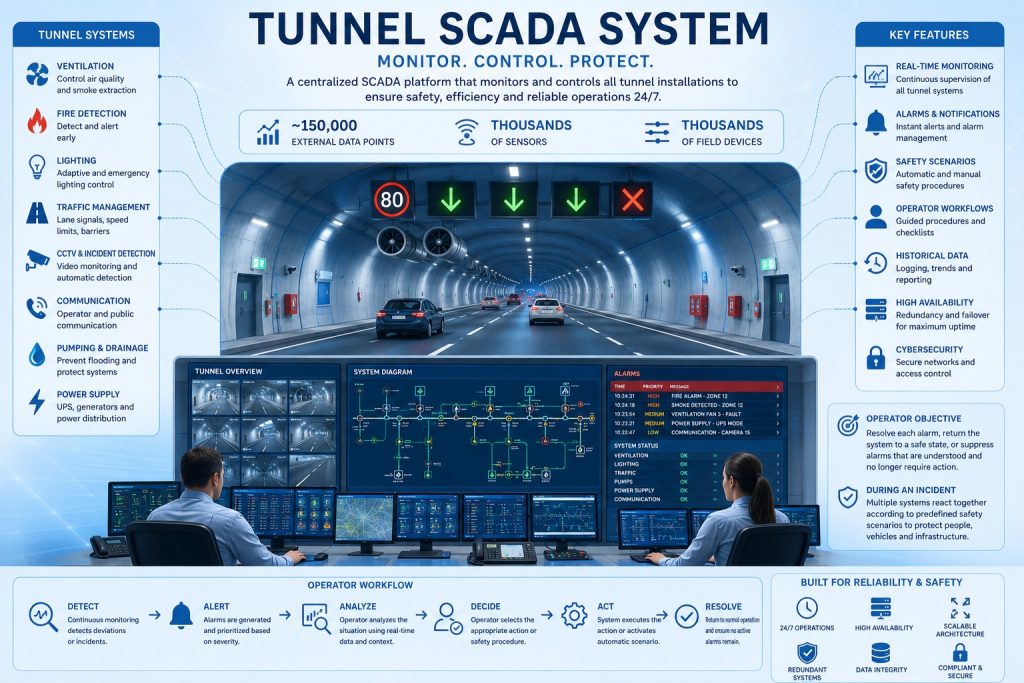
Road tunnels combine a wide range of technical disciplines into one integrated safety system. Every subsystem must operate reliably on its own while also cooperating seamlessly with the others.
A modern tunnel typically includes:
- Ventilation systems that remove smoke during incidents and maintain air quality during normal operation.
- Traffic management systems with lane control signals, speed limits, barriers and traffic lights.
- Fire detection and emergency systems that automatically trigger predefined safety scenarios.
- Lighting systems with multiple illumination levels that adapt to daylight conditions and emergencies.
- CCTV cameras, automatic incident detection base on image processing by AI and communication systems that provide operators with continuous situational awareness.
- Power distribution, UPS installations and backup generators that keep critical systems operational during power failures.
- Pumping stations and drainage systems that prevent flooding and protect technical installations.
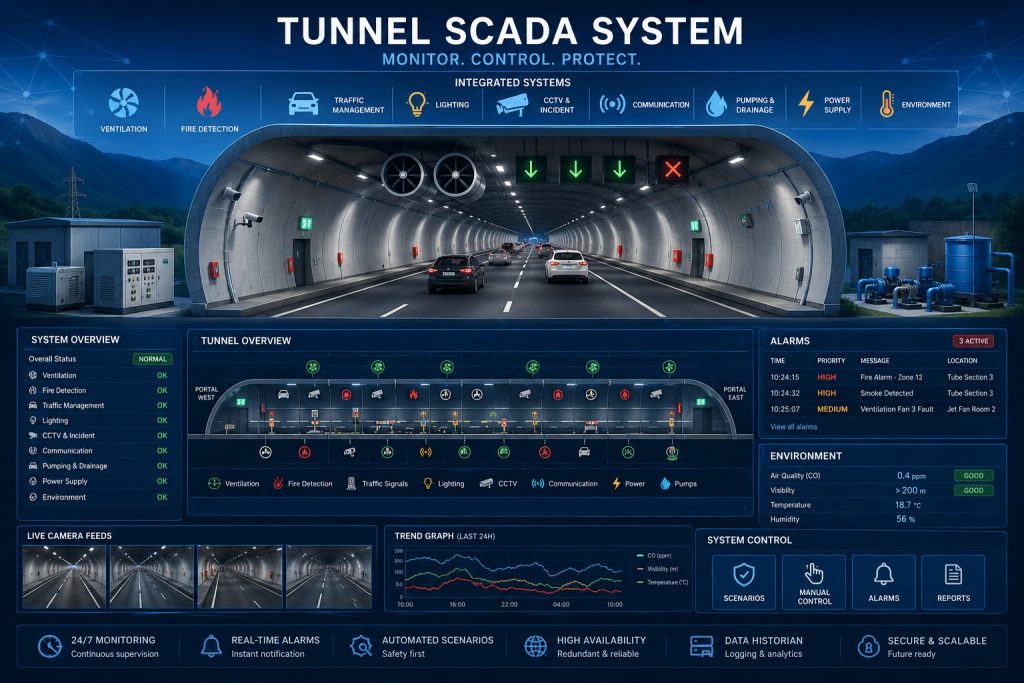
The SCADA platform continuously monitors thousands of sensors and controls thousands of field devices. Operators receive alarms, monitor equipment status and execute predefined operating procedures from a central control room. Their objective is to resolve each alarm, return the affected system to a safe and stable condition, or suppress the alarm when it is known, understood and no longer requires immediate action. During an incident, multiple technical systems must work together according to carefully engineered safety scenarios.
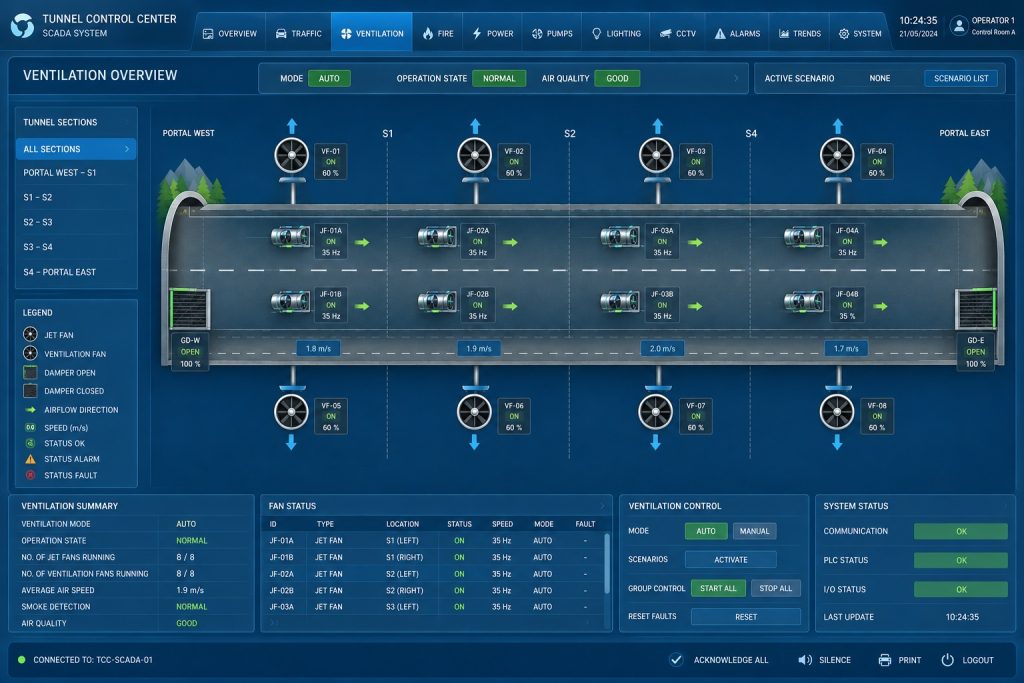
Working on this type of infrastructure demands a solid understanding of electrical engineering, industrial communication networks (OPC-UA, Modbus, TCP/IP), safety principles, operator workflows and the interaction between numerous technical disciplines. That multidisciplinary nature is one of the aspects that made the project both challenging and rewarding.
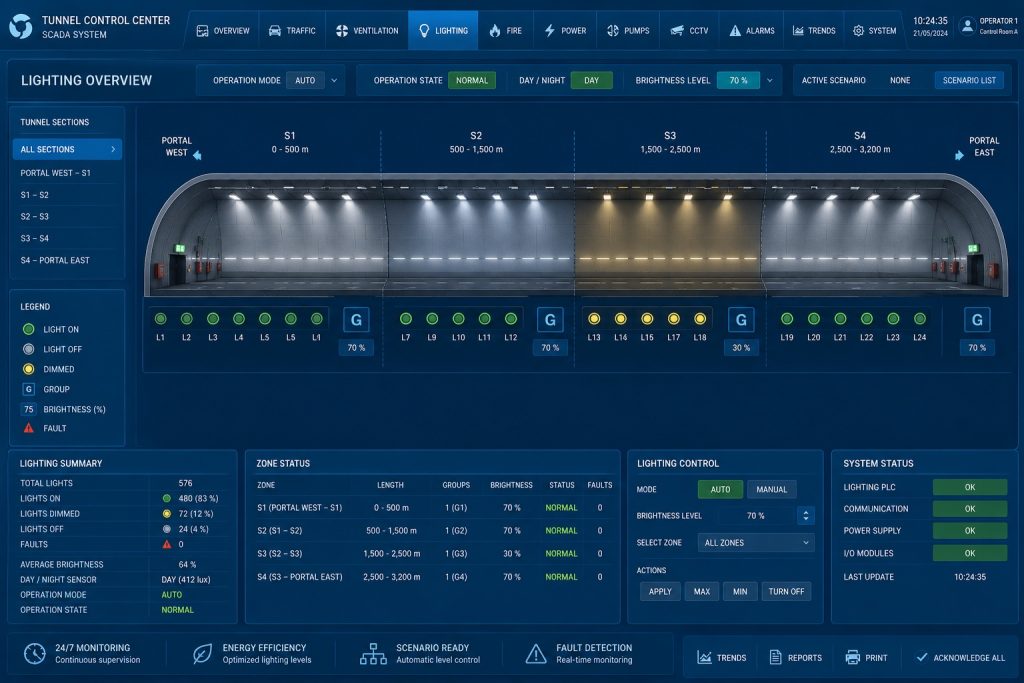
Image: Tunnel SCADA of lighting technique
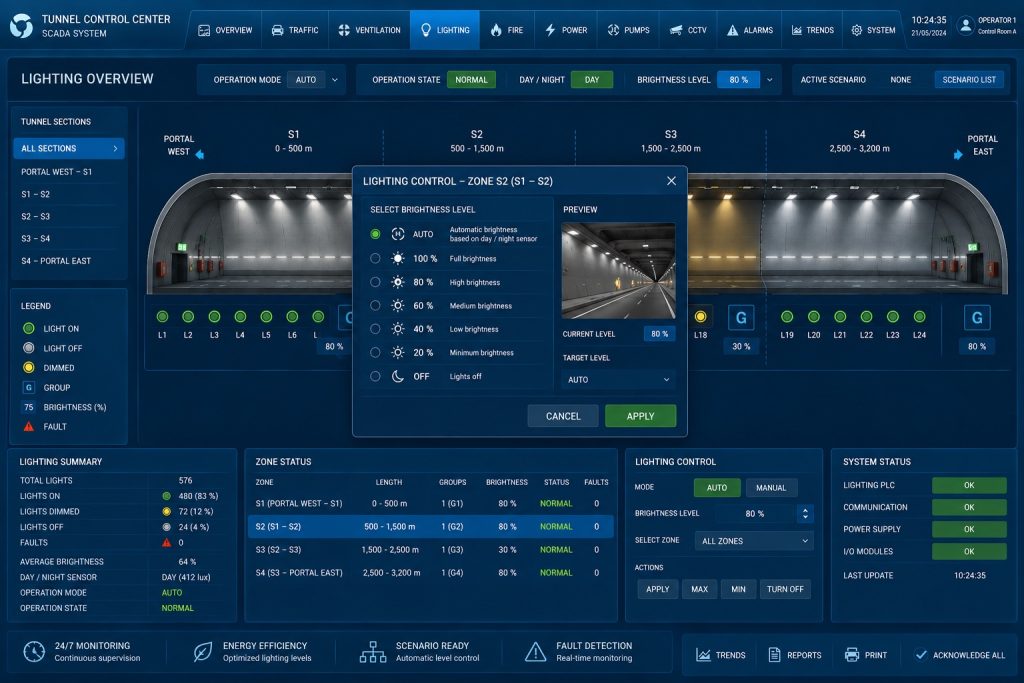
Image: Tunnel SCADA of lighting technique with pop-up to monitor and control the lighting.
What my role involved
My work focused on translating complex tunnel infrastructure into a reliable and scalable SCADA system. This included developing and extending core SCADA functionality, integrating new tunnel installations, and ensuring that the system could grow without compromising stability or operator usability.
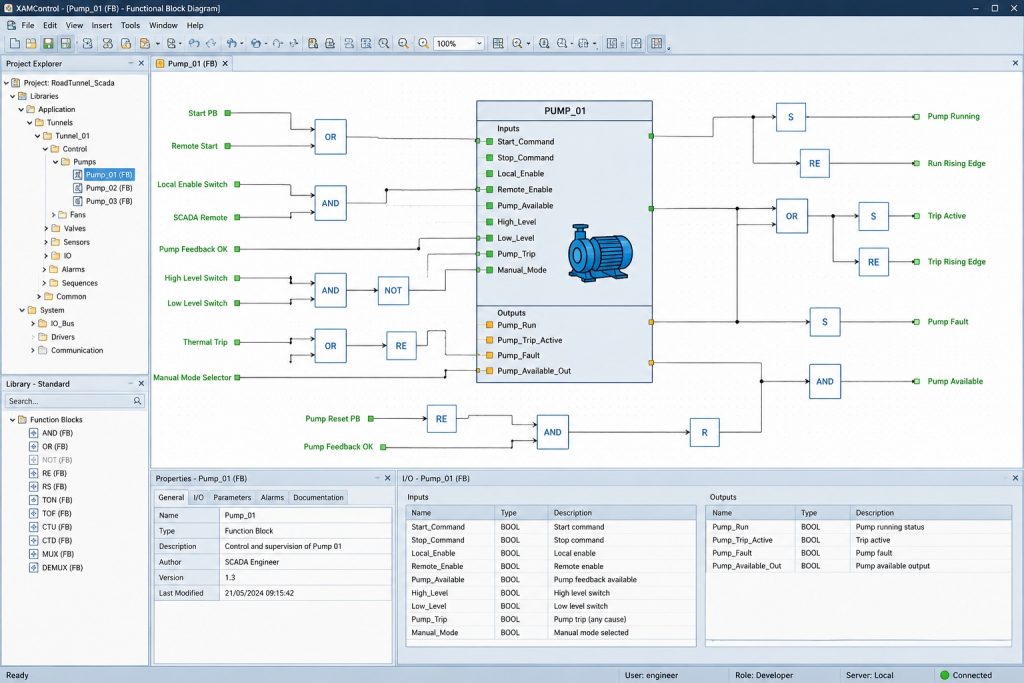
A key part of my responsibility was working on the logic and visualization that operators depend on during normal operation and during incidents. This meant building clear and consistent screens, implementing alarm handling that supports fast decision making, and ensuring that technical states are presented in a way that matches how operators think and act.
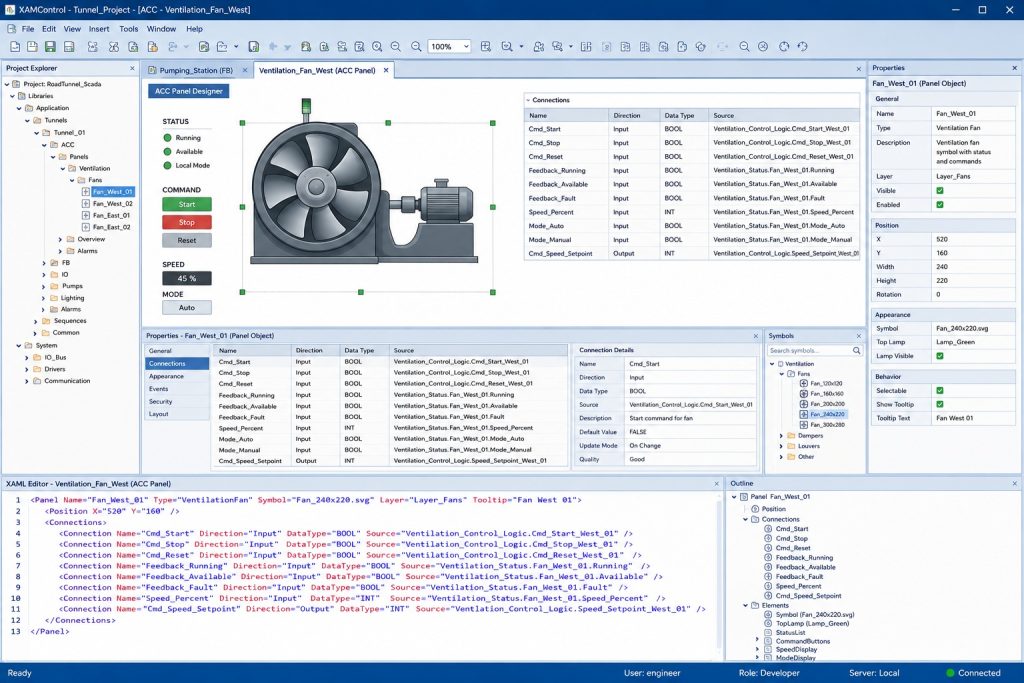
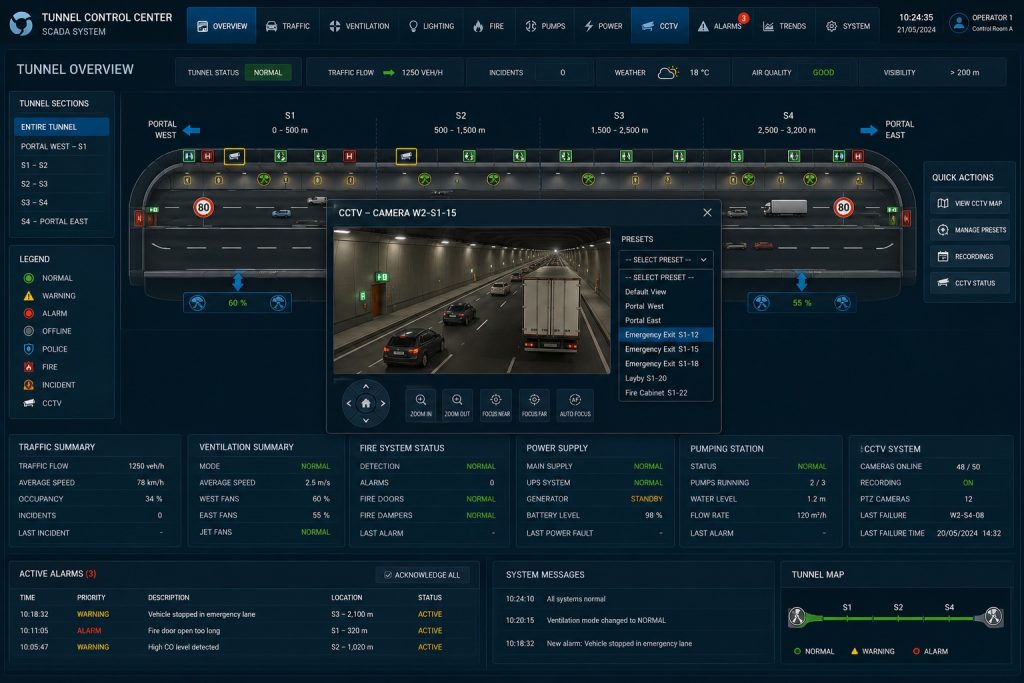
I was also involved in integrating advanced system components such as workflow driven incident handling, scenario management, and centralized supervision of distributed tunnel systems. These elements are essential in large scale environments where human error must be minimized and procedures must be followed consistently.
Working on a nationwide system
One of the most innovative aspects of XAMControl is that it combines the flexibility of an integrated design environment in C# and .NET (IT) with the combination of a virtual PLC (OT) which made into a very versatile and powerful SCADA system. You could make REST and SOAP interfaces and even scenario management screens and as well program classic PLC functional blocks.
In parallel, a dedicated training environment was developed. This allowed operators to train on realistic scenarios without impacting live operations. Supporting such a setup meant designing the SCADA system in a way that could be safely duplicated, isolated, and reset while remaining functionally identical to production.
Integration between SCADA and Video Management System
The system was designed to integrate with other central platforms. One of the most challenging and rewarding integrations was the connection with the video management control center. This brought live visual context into the SCADA environment and significantly improved situational awareness for operators.
Contributing to these integrations strengthened my expertise at the intersection of SCADA, IT infrastructure, and operational technology. It also reinforced my belief that modern SCADA systems are no longer standalone automation tools but core digital platforms within critical infrastructure.
Why this project still matters to me
What I remember most, however, is the team. It was an amazing group of highly skilled and dedicated engineers who shared knowledge, solved complex problems together, and genuinely supported one another. Working with people who were passionate about building reliable infrastructure made every challenge rewarding. I am grateful to have been part of a team that delivered systems millions of people rely on every day without ever noticing they are there.