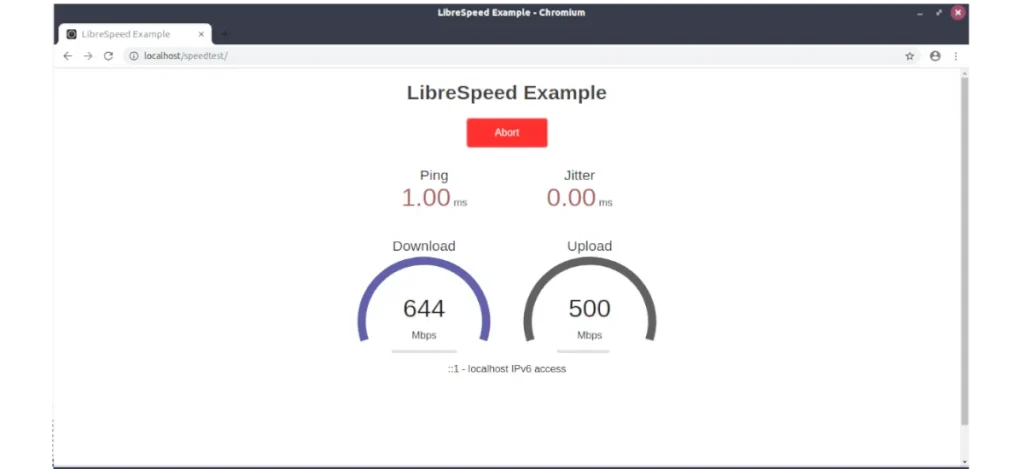
When you want to understand how fast your local network really is, internet speed tests are almost useless. They measure the connection to the outside world, not the performance between your own machines. To get meaningful results inside my home lab, I installed LibreSpeed on an Ubuntu server and used it to measure transfer speed between my computers. Since I have in my network machines with a 1Gb/s, 2,5Gb/s, 10Gb/s interface, this setup allowed me to test real world LAN performance in a controlled and repeatable way, without relying on any external service.
Why LibreSpeed
LibreSpeed is a lightweight, self hosted speed test that runs entirely on your own infrastructure. It measures download speed, upload speed and latency using a simple web interface. Because the server is inside the same network, the results reflect switching, cabling, NICs, drivers and system configuration rather than ISP limitations. For anyone working with networks, servers or testing environments, this makes it far more valuable than public speed test websites.
Installation on Ubuntu
I installed LibreSpeed on an Ubuntu server that is always online as part of my home lab. The setup is straightforward and fits well with a clean Linux based infrastructure. The server acts as a fixed reference point. Every client machine runs the test through a browser, which keeps the setup simple and platform independent. No special client software is needed, just a modern browser.
What I Measured
With LibreSpeed running, I tested transfer speed between multiple machines on my LAN. This allowed me to validate:
• Effective throughput between wired systems
• Impact of different network interfaces
• Consistency of upload and download speeds
• Latency inside the local network
Because the server is under my control, I can repeat the tests after hardware changes, driver updates or network reconfiguration and immediately see the impact.
Why This Matters for Testing and Engineering
From a testing perspective, this setup is useful beyond pure networking. Many software systems depend on predictable data transfer speeds. By knowing the actual LAN performance, you remove uncertainty when diagnosing performance issues in distributed systems, virtualized environments or test setups. It also fits well with a verification mindset. Instead of assuming that the network is fast enough, you measure it and document the result.
A Simple Tool With High Practical Value
Running LibreSpeed on Ubuntu gives a clear and honest view of how your local network performs. It is simple, transparent and fully under your control. For anyone building or testing systems where data transfer matters, this kind of measurement is not optional, it is basic engineering hygiene. For me, it has become a permanent part of my home lab, used whenever I want to validate changes or rule out network performance as a variable.