Context and intent
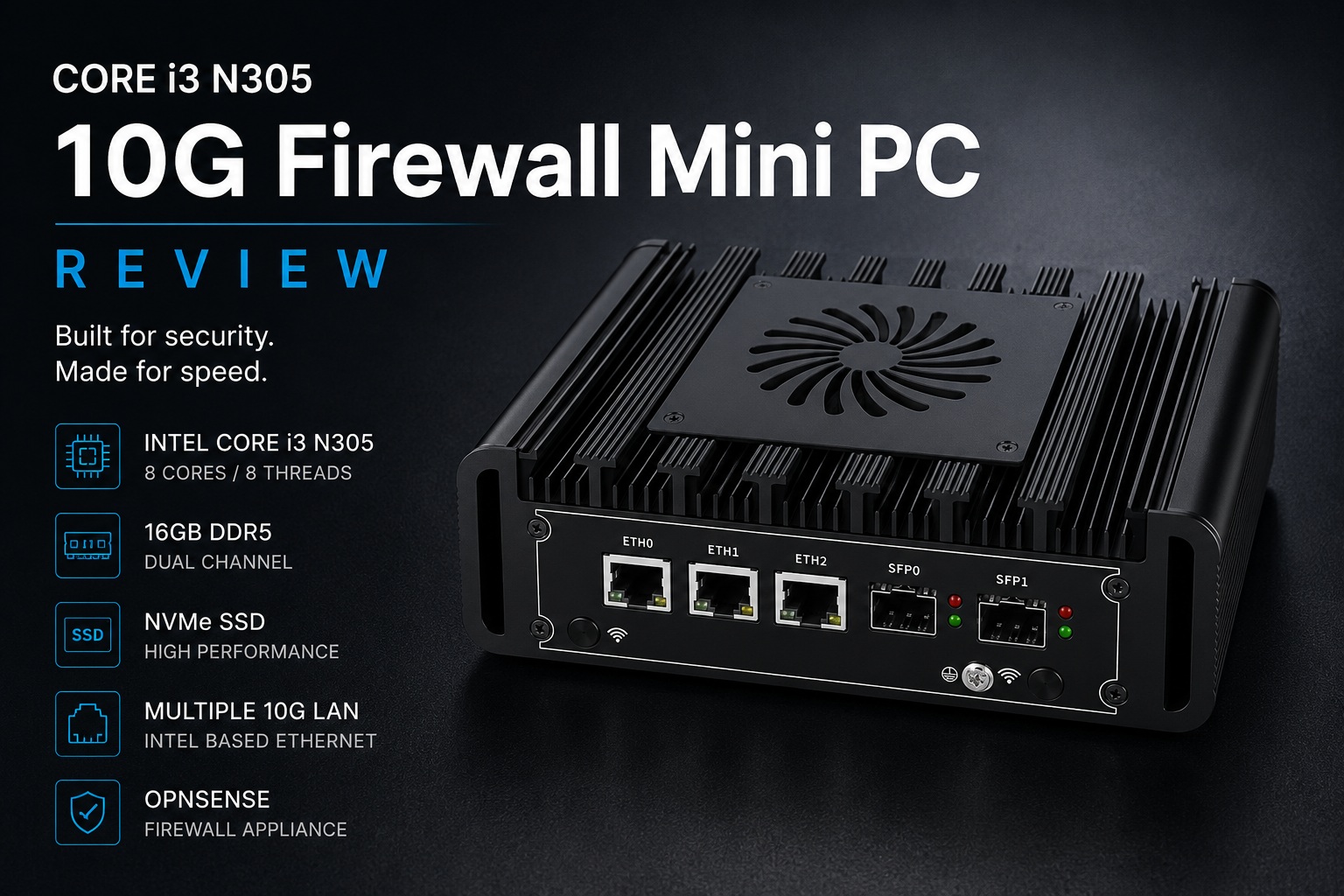
This mini PC was deployed as a dedicated firewall appliance running OPNsense. The primary reason for purchasing it was to prepare for a future upgrade from 2.5 Gb/s to 10 Gb/s networking. Internet speed is an important factor for business operations, and the existing firewall platform would eventually have become a limiting factor.
The purpose of this benchmark review is therefore not to evaluate the system as a conventional office PC. Its strongest feature is not raw CPU, GPU, memory or storage performance, but its high speed 10 Gb/s network interfaces. These capabilities are not properly reflected in a traditional benchmark focused mainly on processor, storage, graphics and memory performance. The system should instead be judged primarily on its suitability as a stable, efficient and high performance firewall appliance.
Hardware overview
The hardware was supplied as a barebone system, to which I added 16 GB of DDR5 memory and an NVMe SSD. After several months of use, it became clear that 16 GB was more than necessary for this application. For a dedicated OPNsense firewall, 8 GB of RAM should be sufficient for most typical configurations.
- CPU: Intel Core i3 N305, Alder Lake N, 8 cores, 8 threads
- RAM: 16 GB DDR5
- Storage: NVMe (capacity not performance critical for this role)
- LAN NIC: Intel based Ethernet (board integrated)
- OS: OPNsense
Build quality and design
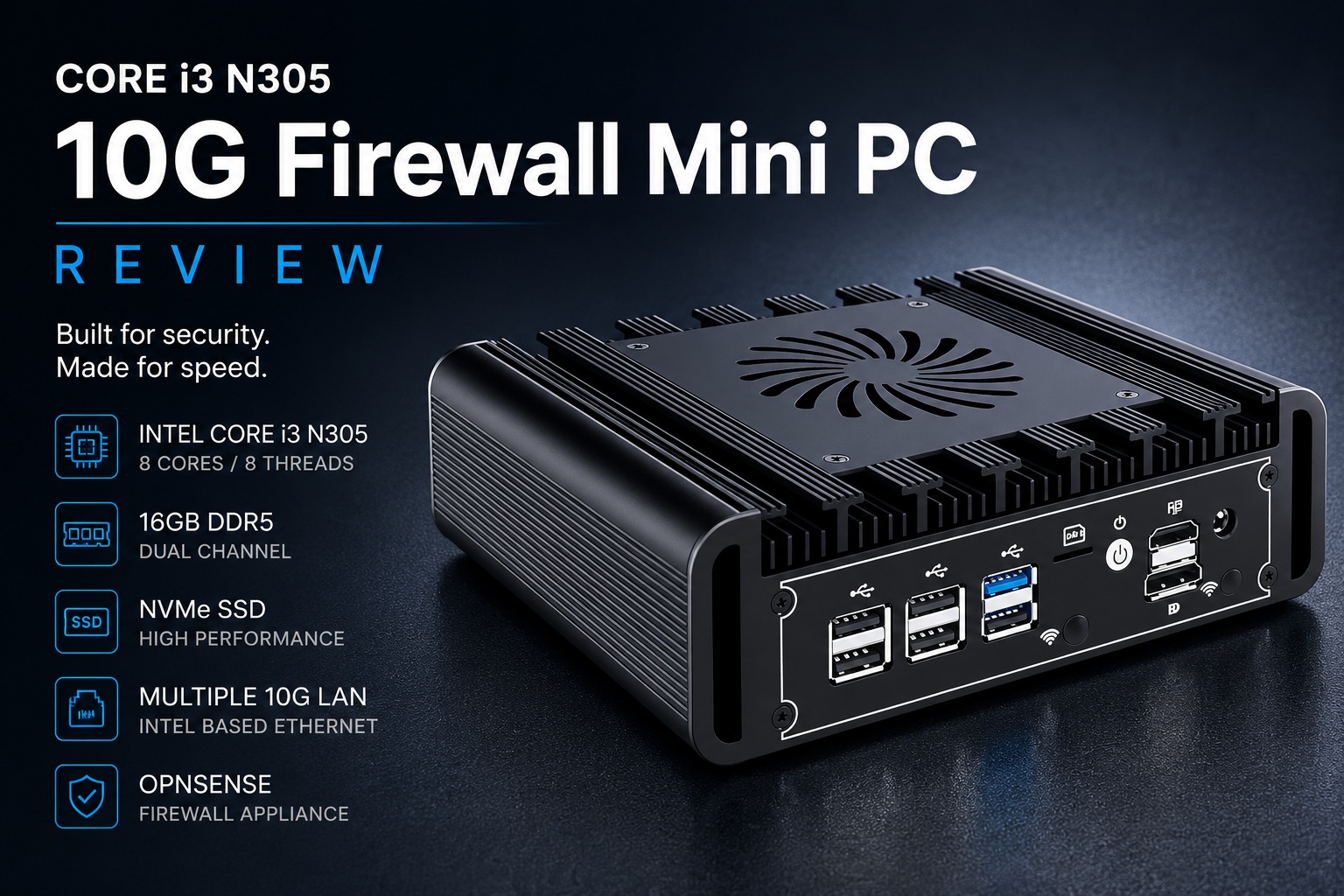
The enclosure is compact and clearly designed for infrastructure use rather than consumer aesthetics. Materials feel more solid than entry level mini PCs. Cooling is active but conservative. Under sustained load, the system remains thermally stable and acoustically unobtrusive. This is not a fanless design, but noise is not intrusive in a technical environment. Expansion options remain limited, as expected for a firewall oriented mini PC, but internal layout and component choice suggest a focus on reliability rather than minimum cost.
Benchmark results
All benchmarks below were executed on this exact unit.
Benchmark Result
Novabench Overall 868
Novabench CPU 481
Novabench GPU 31
Novabench RAM 231
Novabench Disk 125
Cinebench R23 CPU Single 852
Cinebench R23 CPU Multi 2614
Geekbench CPU Single 1312
Geekbench CPU Multi 3999
Geekbench GPU OpenCL 5926
PCMark 10 Overall 3604
PCMark 10 Essentials 7504
PCMark 10 Productivity 5192
PCMark 10 Digital Content Creation 3261
Storage performance
CrystalDiskMark 8.0.6 results
Test Read MB/s Write MB/s
Sequential SEQ1 890.46 810.51
SEQ1M Q1T1 724.15 785.47
Random 4K Q32T1 330.61 214.94
Random 4K Q1T1 50.57 97.47
What the numbers actually say
Compared to entry level N100 systems, the Core i3 N305 is a clear step up. Single core performance is higher and more consistent. Multi core performance scales significantly better thanks to the higher core count. While this is still a low power CPU class, it no longer feels constrained as a N100. For firewall workloads that include inspection, logging, VPN termination, and intrusion detection, the additional cores matter more than peak single thread speed.
Disk performance is notably better than typical budget mini PCs. Sequential and random results are strong enough that storage will not be a limiting factor for firewall logs, state tables, or updates. RAM performance is also improved thanks to DDR5, which helps with concurrent packet processing and background services.
GPU performance is irrelevant for the intended role and behaves exactly as expected for an infrastructure focused system.
Networking: the decisive factor
Unlike many lower cost mini PCs that rely on Realtek or MotorComm Ethernet controllers, this system is equipped with Intel network controllers. For a firewall appliance, this is arguably one of its strongest advantages. Intel NICs have an excellent reputation for driver maturity, reliable interrupt handling and long term stability across operating systems. The system provides multiple 10 Gigabit Ethernet interfaces, making it well suited for high performance routing and firewall workloads. Under OPNsense, the network stack behaves predictably, with stable link negotiation and no unexplained connection drops observed during production use. For a perimeter firewall, this networking platform alone is a compelling reason to choose this system over many lower cost alternatives.
Power usage and thermals
Despite its higher performance envelope compared with Intel N100 based systems, power consumption remains reasonable for continuous 24/7 operation. The cooling system keeps the CPU within safe operating limits without aggressive fan behavior or thermal throttling. For a firewall appliance that must remain stable under sustained network traffic, this balance between performance, efficiency and cooling is appropriate.
However, users expecting completely silent operation may be disappointed. In a quiet office environment, the fan is lightly audible when it switches on periodically to cool the system. Fan activity decreased noticeably after an OPNsense upgrade, and the system became effectively silent during normal operation. This suggests that changes in OPNsense improved overall efficiency and reduced the need for active cooling.
Suitable use cases
Good fit
- Dedicated firewall or router
- OPNsense or pfSense deployments
- VPN concentrator
- Network segmentation and monitoring
- Small office or home lab perimeter security
Poor fit
- Silent living room PC
- Battery powered scenarios
- GPU accelerated workloads
- General purpose desktop replacement
Verdict
Measured performance shows that this Core i3 N305 mini PC is well suited for serious firewall and network infrastructure use. It offers a meaningful performance uplift over entry level low power systems while maintaining acceptable power consumption. Most importantly, the choice of Intel networking makes it a reliable foundation for OPNsense. This is not a general purpose machine pretending to be a firewall. It is a compact system that aligns well with its intended role. For users who need a stable, capable, small form factor firewall and are willing to pay more than the absolute minimum, this platform makes technical sense.