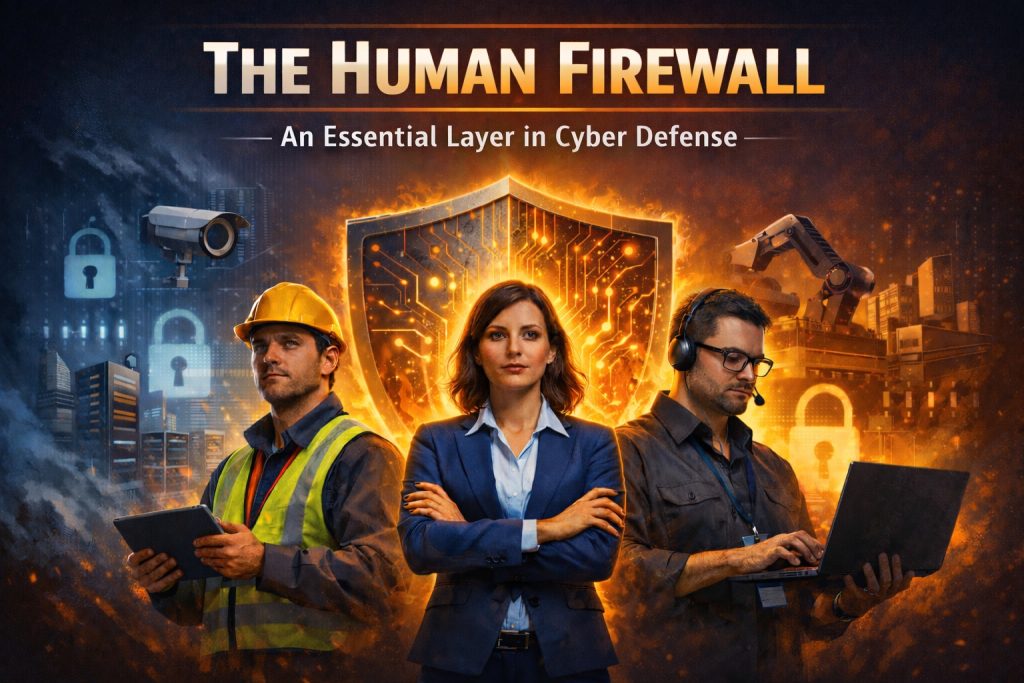
In every security architecture diagram you will see firewalls, IDS systems, endpoint protection, network segmentation, encryption, and monitoring layers. But there is one control that does not sit in a rack. It does not run on Linux. It cannot be patched with a firmware update. It is the human firewall.
What Is the Human Firewall?
The human firewall is the collective awareness, discipline, and security behavior of people inside an organization.
It means:
• Recognizing phishing attempts
• Verifying unexpected payment requests
• Refusing to plug unknown USB devices into critical systems
• Reporting anomalies instead of ignoring them
• Following access control procedures even under pressure
Technology blocks known threats.
People detect suspicious intent.
When trained correctly, humans become an adaptive security layer that reacts faster than signatures and smarter than static rules.
Why Technology Alone Is Not Enough
Modern infrastructure, especially in regulated environments such as IT and OT systems, relies on layered defense:
• Network segmentation
• Encryption
• Strong authentication
• Logging and monitoring
• Access control policies
Yet most successful breaches still begin with:
• Phishing emails
• Social engineering
• Credential theft
• Misconfiguration
• Insider negligence
An attacker does not need to break AES encryption if they can convince someone to hand over credentials.
The attack surface includes people.
The Human Firewall in IT vs OT Environments
In traditional IT environments, human error often leads to data breaches. In OT environments, the consequences can be more severe:
• Production downtime
• Physical damage
• Safety incidents
• Regulatory violations
An engineer bypassing a procedure to “save time” can introduce systemic risk. A technician ignoring a certificate warning can compromise a segmented network. In high availability environments, operational discipline is cybersecurity.
Characteristics of a Strong Human Firewall
A mature organization builds this layer intentionally.
1. Awareness Without Fear
Security culture should not be based on blame.
It should reward reporting and transparency.
People must feel safe admitting mistakes.
2. Clear Procedures
Security awareness without structured processes leads to inconsistency.
Example:
If someone receives a suspicious email, they must know:
• Who to contact
• How to escalate
• What not to do
Ambiguity weakens the human firewall.
3. Realistic Simulations
Phishing simulations, incident drills, and tabletop exercises create muscle memory.
Training must reflect real attack techniques, not outdated examples.
4. Least Privilege Thinking
People should understand why:
• Admin rights are restricted
• Multi factor authentication exists
• Network segmentation is enforced
When controls are understood, they are respected.
Common Weak Points
Even technically strong teams struggle with:
• Overconfidence
• Routine fatigue
• Shadow IT
• “Temporary” policy exceptions that become permanent
Cybersecurity incidents often begin with:
“It will only take a minute.”
Security maturity means resisting that mindset.
Building the Human Firewall: A Practical Approach
For SMEs and engineering driven companies, the following approach works:
- Short, focused training sessions instead of long generic courses
- Regular micro reminders integrated into workflows
- Clear incident reporting channels
- Leadership example, not just policies
- Measurable KPIs such as reporting rate and simulation resilience
Security awareness should be treated as an operational control, not as HR compliance.
The Entrepreneurial View
From a business perspective, the human firewall is not just risk mitigation. It is competitive advantage.
Organizations that prevent incidents:
• Maintain uptime
• Protect reputation
• Reduce insurance exposure
• Avoid regulatory fines
Security culture directly impacts continuity and trust. In highly regulated or safety critical sectors, this becomes existential.
The Future: Human Firewall Meets AI
AI will detect anomalies faster. Automation will block threats earlier.
But attackers also use AI.
The human firewall will evolve into:
• Critical thinking layer
• Context validation layer
• Ethical decision layer
Technology processes signals.
Humans evaluate intent.
Final Thought
Next to your technical firewall you need a human firewall.
It is the engineer who questions unusual behavior.
It is the operator who refuses unsafe shortcuts.
It is the employee who reports a suspicious email instead of clicking it.
Cybersecurity is not only architecture. It is culture. And culture is built deliberately. If you are building secure IT or OT systems, start with technology. But never forget to invest in the layer that thinks. That layer is human.