Secure, Structured Communication for Modern Industrial Systems
OPC UA is what happens when industrial communication grows up. It was designed to solve the limitations of older field protocols such as Modbus. Instead of just reading memory addresses, OPC UA provides structured data, security, authentication, and a service oriented architecture. It is not just a transport protocol. It is an information modeling framework.
What OPC UA Actually Is
OPC UA stands for Open Platform Communications Unified Architecture.
It is:
• Platform independent
• Service oriented
• Secure by design
• Object oriented
• Vendor neutral
Unlike classic OPC based on Windows COM and DCOM, OPC UA runs on Windows, Linux, embedded devices, PLCs, edge gateways and even cloud systems.
It does not depend on Microsoft technologies.
Architecture Overview
OPC UA uses a client server model, but it also supports publish subscribe patterns.
The stack consists of:
Application Layer
OPC UA Services
Security Layer
Encryption, Signing, Authentication
Transport Layer
UA TCP or HTTPS
Network Layer
IP
It typically uses port 4840 for UA TCP communication.
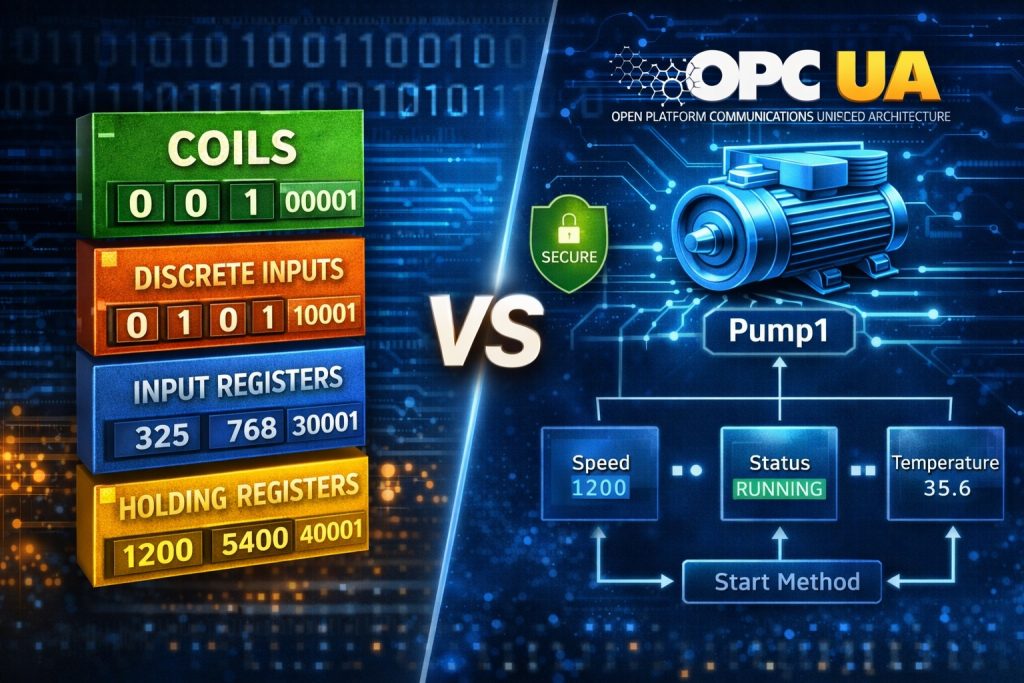
The Big Difference: Information Modeling
Modbus reads addresses like:
40001
40002
40003
OPC UA exposes structured objects.
Instead of reading a raw register, you might access:
Pump1.Speed
Pump1.Status
Pump1.Temperature
These are nodes in an address space.
OPC UA builds a full object model inside the server.
Everything is represented as nodes:
• Objects
• Variables
• Methods
• Data types
• Events
Each node has attributes and relationships.
This makes integration much cleaner in complex systems.
Security by Design
Security is built into OPC UA from the start.
It supports:
• Message encryption
• Message signing
• X 509 certificates
• Mutual authentication
• User authentication
• Role based access
Common security policies include:
Basic256Sha256
Communication is encrypted using asymmetric and symmetric cryptography, and integrity is guaranteed by digital signatures.
In regulated OT environments, this is a major advantage over legacy protocols.
Communication Model
OPC UA offers two main communication styles:
Client Server
The traditional model.
Client connects to server
Client reads or writes nodes
Client calls methods
Very common in SCADA systems.
Publish Subscribe
Designed for high performance and scalable systems.
Publisher sends data to subscribers
No direct request response cycle
This is used in:
• Large distributed systems
• Edge to cloud architectures
• High throughput data streaming
Services
OPC UA defines services such as:
• Read
• Write
• Browse
• Subscribe
• Call
• CreateSession
• ActivateSession
This makes the protocol far more than simple memory exchange.
Data Types
OPC UA supports complex data types:
• Structures
• Enumerations
• Arrays
• Custom types
It can even define domain specific information models.
For example:
• PackML
• ISA 95
• Companion specifications for robotics, energy, pharma
This allows semantic interoperability, not just data transport.
Real World Use
Modern platforms such as WinCC OA, Ignition, and most new PLC platforms support OPC UA natively.
It is widely used in:
• Manufacturing
• Energy systems
• Infrastructure
• Pharmaceutical production
• Laboratory automation
It is also a key enabler for Industry 4.0 architectures.
Strengths
• Secure by design
• Structured information modeling
• Platform independent
• Scalable
• Extensible
• Future proof
Weaknesses
• More complex to configure
• Certificate management can be painful
• Heavier stack than Modbus
• Requires deeper understanding
If misconfigured, security can still be weak.
Security is built in, but it must be configured correctly.
Modbus vs OPC UA
Modbus:
Memory oriented
Simple
No built in security
Polling based
OPC UA:
Object oriented
Secure
Service based
Supports subscriptions
Supports complex models
Modbus is good for simple deterministic data exchange.
OPC UA is designed for system level interoperability.
Practical Example
Instead of reading register 40001 for a pump speed, an OPC UA client might:
Browse the address space
Locate Pump1 object
Read the Speed variable
Subscribe to Status changes
Call Start method
This is structured, self describing communication.
Why OPC UA?
In modern OT architectures, systems are no longer isolated islands.
Data flows to:
• MES systems
• Data historians
• Analytics platforms
• Cloud systems
A protocol that supports authentication, encryption and structured modeling becomes essential.
OPC UA provides that foundation.