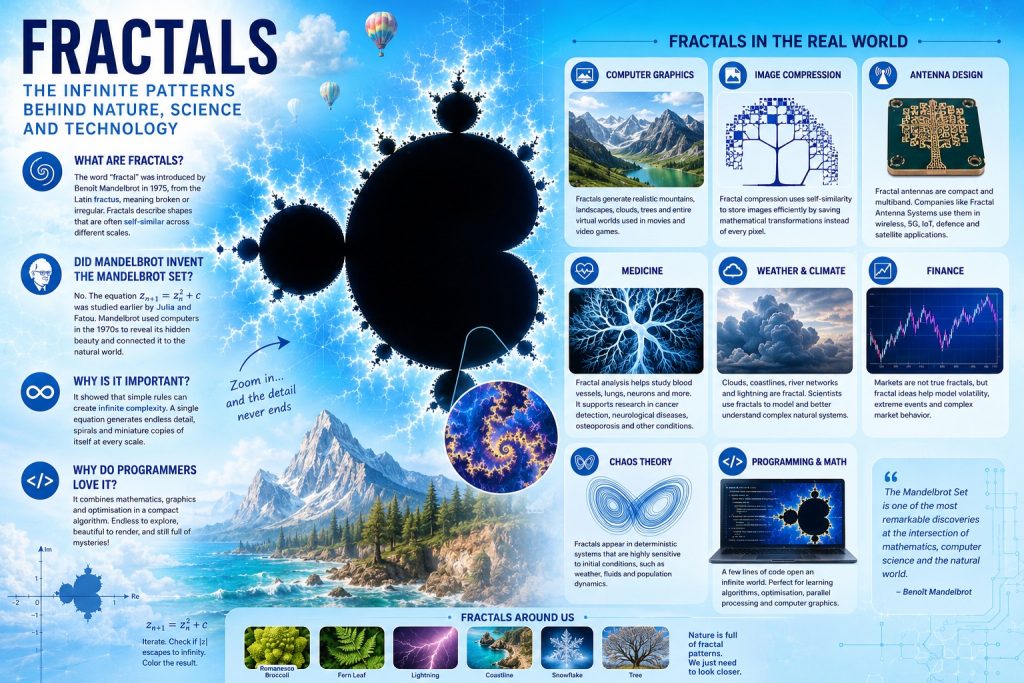
Why are they called fractals?
The word fractal was introduced by the Polish French mathematician Benoît Mandelbrot in 1975. He derived it from the Latin word fractus, meaning broken, fractured or irregular.
Before Mandelbrot’s work, mathematicians had words to describe smooth objects such as circles, spheres and straight lines. Nature, however, rarely produces perfect geometric shapes. Coastlines, mountains, clouds, trees and lightning all have rough, irregular boundaries that cannot easily be described with traditional geometry.
Mandelbrot realised that many of these seemingly chaotic structures share one remarkable property. When you zoom in, smaller parts often resemble the whole. This property became known as self similarity, and objects with this behaviour became known as fractals.
Did Mandelbrot invent the Mandelbrot Set?
Surprisingly, no. The mathematical formula behind the Mandelbrot Set had already been studied decades earlier by French mathematicians Gaston Julia and Pierre Fatou during the early twentieth century. They investigated what happens when the following equation is repeatedly applied:
At the time, however, computers did not exist. Drawing millions of iterations by hand was practically impossible, making it extremely difficult to understand the behaviour of the equation.
In the late 1970s, while working at IBM, Benoît Mandelbrot used computer graphics to visualise the equation. For the first time, the hidden beauty of these mathematical objects became visible. The now famous Mandelbrot Set revealed an endlessly detailed world that no one had ever seen before.
Although Mandelbrot did not invent the equation itself, he recognised its importance, visualised it using computers and connected it to many natural phenomena. His work transformed an obscure mathematical topic into an entirely new field of geometry.
Why was the discovery so important?
The Mandelbrot Set demonstrated that extremely simple mathematical rules can generate almost unlimited complexity. A single equation containing only squaring and addition creates an infinite structure filled with spirals, miniature copies of itself and endlessly varying patterns. No matter how far you zoom in, new details continue to appear. This challenged the traditional idea that complex systems always require complicated mathematics.
Where are fractals used today?
Fractals are much more than beautiful mathematical images. They have practical applications across science and engineering.
Computer graphics
Fractal algorithms generate realistic mountains, landscapes, clouds, coastlines, trees and entire virtual worlds. Many films and computer games use fractal based terrain generation because natural landscapes exhibit fractal characteristics.
Image compression
Some image compression techniques exploit repeating self similar patterns, allowing images to be stored more efficiently under certain conditions. Around 1992, many researchers believed fractal compression might become the successor to JPEG because it had several attractive properties. Unfortunately, the encoding process is extremely slow. As JPEG 2000, WebP and later AVIF appeared, fractal compression gradually disappeared from mainstream use.
Antenna design
Fractal antennas contain repeating geometric patterns that allow a compact antenna to operate efficiently over multiple frequency bands. They are used in wireless communication, satellites and mobile devices. In 2026, the clearest active commercial user is Fractal Antenna Systems, a specialist American antenna company. It currently sells fractal based antennas and related RF technology for several markets:
Medicine
The human body contains many fractal structures.
- Blood vessels branch repeatedly.
- The lungs maximise surface area using fractal like branching.
- Neurons form highly complex branching networks.
Doctors and researchers use fractal analysis to study diseases and detect abnormalities in medical images. For example, fractal measurements have been studied for distinguishing low-grade from high-grade gliomas and for examining whether pulmonary nodules are likely to be malignant.
Weather and climate
Clouds, coastlines, river networks and lightning all exhibit fractal characteristics. Scientists use fractal mathematics to model these natural phenomena more accurately.
Finance
Although financial markets are not true fractals, Mandelbrot demonstrated that stock markets display patterns that cannot always be explained by traditional statistical models. His research influenced modern quantitative finance and risk analysis.
Chaos theory
Fractals are closely connected to chaos theory. They help scientists understand systems that are deterministic yet highly sensitive to small changes, such as weather prediction, population growth and fluid dynamics.
Why do programmers love the Mandelbrot Set?
The Mandelbrot Set is a rewarding programming project because it combines mathematics, graphics and optimisation in a surprisingly compact algorithm. With only a few lines of JavaScript, you can generate an infinitely detailed object that mathematicians are still actively researching today. Every optimisation, colour palette and zoom level reveals something completely new, making the Mandelbrot Set an ideal project for learning computer graphics, numerical algorithms and high performance programming.